
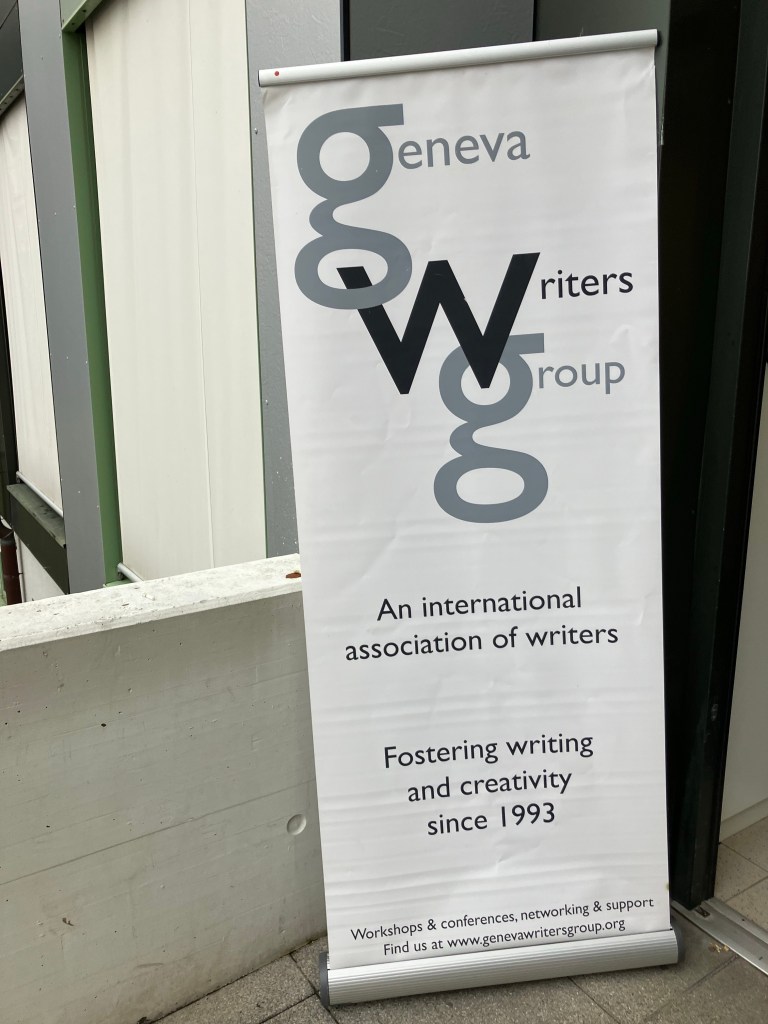
I’m spending this weekend at the Geneva Writers’ Conference, attending workshops on pretty-much every aspect of writing and publishing. And I’m running the Geneva 20km. Because I can’t just do one thing at a time, apparently.
The conference is taking place at Webster University, just out of town in a place called Bellevue, which doesn’t live up to its name because it’s suffering from a severe case of roadworks. Here’s a picture of Webster.

You may notice that there’s nobody in this photo. This isn’t because I was there alone; it wouldn’t have been a very good conference were that the case. I just wasn’t sure if I needed people to sign a disclaimer if I took a picture of them – and didn’t want to spend my time researching the legal implications. I’m not going to post many outside shots, either, as although winter’s first snow graces the mountains, down here it’s raining continuously.
On the Saturday, I attended three workshops. The first was on the changing face of publishing, and it reconfirmed that self-publishing is probably the best route for me- although a new model of ‘hybrid publishing’ piqued my interest. This is about combining the freedom of self-publishing with the support on offer from a professional outfit, splitting the costs and the profits.
Next up was a lively workshop about writing historical fiction, which was surprisingly relevant to me, given that I have no plans to write a historical novel. The workshop turned out to be about research and authenticity – striking the balance between ensuring realism, period texture and interest, without spending all your time doing research. It was run by Tim Leach, who was interesting enough to make me consider picking up his novel set in tenth- century Iceland. Not my usual genre…
The afternoon started with a workshop on voice in nonfiction, which levered off a study of Levels of Life, a memoir by Julian Barnes about grief. It was pretty full-on, and reminded me of school English lessons and why I didn’t pursue English literature studies at A-level and university. I’m just not someone who enjoys picking a text apart – I prefer to absorb and reflect on it alone. The workshop was masterfully run, though, and the text – its layers and its depth – was profoundly moving. Still, I left early, to give myself some mental space between that and a 1-1 I had booked with an agent.
April Eberhardt specialises in debut authors, helping them to navigate the system. She describes this as her ‘philanthropy’, because it doesn’t pay very well. She ran the morning’s workshop on the changing face of publishing, so I knew she would be a great resource for checking the direction I’m taking, Her description of the traditional publishing industry was, frankly, depressing – in terms of timescales, profits and the chances of getting picked up. Talking with her reinforced that self-publishing or approaching indie publishers is the way to go for now, at least until I have established more firmly my ‘brand’ of taking a different angle to established genres. Traditional publishers want big names or genre fiction, and I offer neither of those!
A great connection, and it was great to get some advice from someone in the industry.
The evening finished with a panel discussion on the publishing industry, at a somewhat more meta level than discussed earlier in the day. AI was mentioned but, happily, did not dominate the discussion. The highlight for me was a comment from author Julie Myerson about how much she would hate having her writing critiqued by a group of other writers (a staple of some writers’ retreats and classes). A woman after my own heart. It felt good knowing I wasn’t alone.
 P.J. Murphy's Writer Site
Leave a comment