
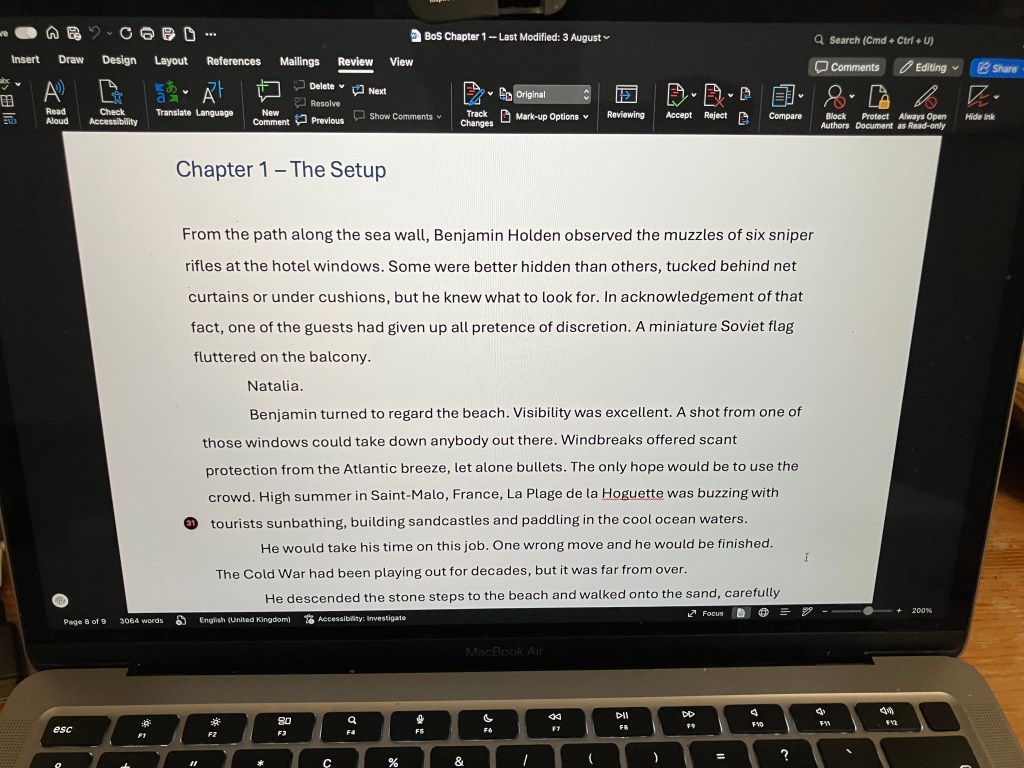
I’m halfway through the first draft of my next novel, Beach of Spies, and I’m pleased to report that it’s not very good.
The plot meanders, the jokes miss (yes, even more than usual), and one of the characters changes her name partway through, but I’m very happy with it. This is because I cut myself a LOT of slack for my first drafts.
Over the course of writing five novels, I’ve developed a sort of method. I say ‘sort of’ because up until writing this blog, I’ve never sat down and thought about it this way – but I’ve realised this is generally how I work. I write my novels across at least four drafts, which look something like this:
- Get those ideas down.
- Make sure it fits together and works.
- Make it a pleasurable reading experience.
- Tidy up the language.
The advantage of this approach is that it enables me to focus on one thing at a time. It’s extremely difficult to focus on plot, for example, while I’m trying to make the dialogue zing and the prose sound pretty. On the other hand, it’s liberating to be able to say “don’t worry, I’ll sort that out later” without feeling a nagging guilty feeling. It’s my method – no apologies!
Hence, my bad first draft.
In most other ways, I am a “Don’t put off to tomorrow what you can do today” sort of guy, but not on this!
It’s not just me. I went on a writing retreat with Arvon last year, and one of the key messages was that you have to get something down; you can work on making it good later. And you can see the sense of it. If you have a bad first draft, at least you have something (albeit bad). If you haven’t even finished the first draft you have, well, nothing.
So many aspiring authors fail because they try to make what they’re producing perfect before moving on – and they give up before they get to the end of the novel. If they’re anything like me, they probably have a realisation later on, which necessitates some adjustments earlier on. How much more painful are those rewrites when you’ve already been slaving over the language?
There are downsides to this approach. One is that if you share a draft with someone when you know it has a bunch of issues, you’re likely to get a lot of feedback about things you already know, rendering the whole process of asking for feedback a bit pointless. Then, there’s the confidence aspect. You’ve got to be able to push on, knowing that your creation will only be any good after several rounds of edits. It can be challenging to work on something for a long time without having anything ready to share.
So, here I am, pressing on with my first draft (when I’m not writing blog posts). Look out for future posts when I tell you how I’m working to actually make it good!
P.S. for those of you receiving this post by email, here’s an Easter Egg for you that you might otherwise miss: a photo of the first paragraphs of Beach of Spies. Don’t say I never give you anything…
 P.J. Murphy's Writer Site
Leave a comment